

Journey through Aqua Marina
A Democratic Adventure for School Classes
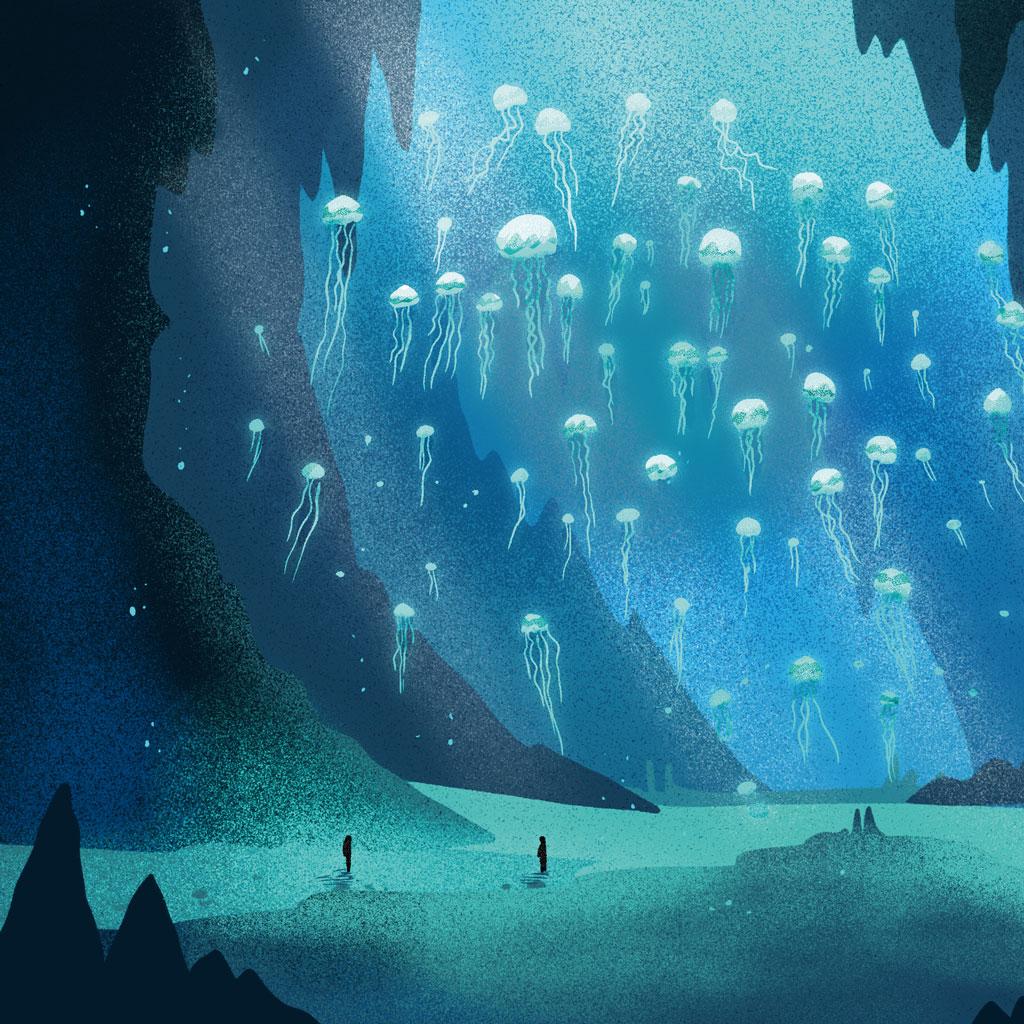
Journey through Aqua Marina is an adventure-filled teaching unit on democracy. While exploring the fictional underwater world of Aqua Marina, students encounter democratic principles and values in a playful, engaging way, and are able to connect their experiences with concrete subject knowledge.




Teacher Guidelines
Background Information
Idea
Journey through Aqua Marina is an adventure-filled teaching unit on democracy. While exploring the fictional underwater world of Aqua Marina, students encounter democratic principles and values in a playful, engaging way, and are able to connect their experiences with concrete subject knowledge.
Duration: 90 minutes
Age: 13–14 years
Group size: 5–36 students
How the Game Works
Phase 1 | Introduction
Students are introduced to the underwater world through a story that can be listened to as an audio play, or read aloud. The students are then tasked with helping an underwater society protect itself from impending chaos.
Phase 2 | Game Phase / Group Work
Students embark on an imaginary journey in small groups, traveling through three stations. At each station, they complete tasks related to a democratic principle:
Background Information freedom of opinion, rule of law, or free elections. Once all groups finish, the end of the story can be played as audio, or read aloud.
Phase 3 | Transfer and Reflection
After the group work, students use individual worksheet to link their underwater experiences with the technical terms for democratic principles encountered during the game. The topic of democracy can then be discussed and reflected upon collectively.
Objective
This teaching unit helps students develop a range of skills:
- Engaging with the topic of democracy
- Encountering and understanding democratic principles
- Reflecting on democracy and forming personal connections
- Applying decision-making processes
- Handling conflicts and practicing argumentation
- Actively participating in group decisions
Overview Download Material
Teacher Materials
Intro-Audio record (download) | Outro-Audio record (download) OR Story Sheet (download)
- Version A: Intro-Audio record (download) | Outro-Audio record (download)
- OR Version B: 1 Story Sheet (download) reading aloud
Material for Group Work | Print 1 per Group
Download Group Material
- 4 station cards (front & back)
- 3 question cards
- 1 group notebook (5 pages)
- 1 text puzzle
Individual work materials | Print 1 per student
Download individual work materials
- 1 democracy worksheets
Preparation
Prepare Materials
1. For each small group (5–6 students), prepare one game set containing:
- 1 set of station cards 1–4
- 1 set of question cards (3 different questions)
- 1 copy of the group notebook (5 pages)
- 1 copy of the text puzzle
- 1 pair of scissors
- 1 glue stick
2. For each student, prepare:
- 1 copy of the democracy worksheet
Prepare the Story
The story is available in two formats: as a story sheet that can be read aloud by the teacher in the classroom (contained in this box) or as an audio play (downloadable via QR code) that can be played in the classroom. The content is identical, but the audio play is recommended for the vivid, immersive atmosphere it creates.
Using the Audio
Download the audio files for the beginning and ending of the story so that you can play them during the lesson. Ensure that you have a playback device available (e.g., smartphone/laptop and speaker).
PHASE 01 | Introduction
Format: Whole class + audio recording
Duration: 15 minutes
Goal: Engage with the topic of democracy
Material: Audio file / Story sheet
Step 1: Introduce the Lesson | 03 minutes
As the start of the lesson, you should do about the following things with your class:
- Introduce the topic: democracy
- Place the topic in the broader teaching context (e.g., as part of a series of lessons)
- Explain the unique structure of the lesson, which combines an unusual story with group work and discussion.
Step 2: Play or Read the Story | 07 min
After welcoming the class, the teacher asks them to listen to the beginning of the story that was mentioned earlier. Depending on the technical setup, it can be played as an audio file, or the teacher can read aloud from the story sheet. (See Preparations, p7). After this part of the story has been told, clarifying questions (e.g., about language) can be answered with the whole class.
Step 3: Divide into Groups | 05 min
The teacher now divides the class into small groups of 5–6 pupils. Each small group has a group table.
NOTE: Arrange tables or desks for group work. Using multiple rooms is also possible.
PHASE 02 | Game Phase
Format: Group work
Duration: 45 minutes
Goals: Encounter and understand democratic principles, apply decision-making methods,handle conflicts and practice argumentation, participate actively in group decisions
Material per group: 4 station cards, 3 question cards (station card 2), 1 copy of the text puzzle (station card 4), 1 copy of the group notebook, 1 pair of scissors, 1 glue stick
Game Phase Instructions
The following phase involves four stations, each with a task that students work through sequentially as a group. The tasks (which are the same for all groups) and the corresponding materials can be found on the station cards. Each group receives a game set, and the teacher has several options for organising the group work:
Option 1
From the start, the groups receive all the tasks and materials for the game sets, read through them independently and work on them at their own pace within the set time (if necessary, the teacher can alsogive time signals to help the students keeping track). Questions can be addressed in a one-on-one discussion with the teacher.
Option 2
The teacher gradually gives the groups the individual tasks and materials from the game sets, thereby providing a time structure. The pupils read and work on these independently, clarifying any questions with the teacher directly.
Option 3
The individual station cards are read aloud in front of everyone and questions can be addressed in a whole class discussion. The pupils then work in groups until the teacher announces the next task or phase (again with preliminary whole class discussion, if necessary).
Note: The method chosen should reflect the age of the pupils and their level of independence, the experience with group work that learners and teachers have, and what is possible in the space of the classroom.
Station Instructions
All stations work the same way:
- Look at everything on the front of the card.
- Complete the task on the back.
- Record results in the group notebook.
Station 1: Travel Preparations | 05 min
Before the journey begins, students assign roles to the group members and choose a group name. There are five suggested roles. If the group is smaller, one person can take on two roles. Roles can also be shared or left out.
Station 2: The Cave of a Thousand Questions | 15 min
At this station, pupils discuss various aspects of living together in harmony and reaching democratic agreements, in line with the democratic principle of freedom of opinion. For this, they are given three question cards which ask them to take a position and discuss it.
Station 3: At the Marketplace | 10 min
Pupils work together to establish rules in order to learn about the principle of the rule of law. Apart from the station card and the group notebook, there are no other materials.
Station 4: The Silver Seagrass Meadows | 15 min
The final task in the group work focuses on decisionmaking methods, and on free elections as one possible method of decisionmaking. This station includes a text puzzle, which is provided as a photocopiable worksheet. The task is to piece together fragments of text to form four coherent texts about decision-making methods, which requires students to read and learn about the methods described. Finally, each group agrees on the decision-making method that they believe is appropriate for the situation.
Ending the Game Phase | 05 min
After completing the final station, the teacher announces that the class will listen to the end of the story. As with like the first part, the end can played as an audio file or read aloud by the teacher from the story sheet, depending on the technical setup (See Preparation, p7).
PHASE 03 | Conclusion
Format: Individual work + whole group discussion
Duration: 30 min
Goals: Learn democratic terminology, reflect on democracy and develop their personal understanding
Material: 1 democracy worksheet per student
Step 1: Transfer | 15 min
Bringing the results of the group work into contact with reality, pupils work individually on a worksheet that asks them to match what happened in the fictional world with real world democratic principles and terminology.
Answer key
Cave of a Thousand Questions → Freedom of opinion (Key terms: expressing opinions, debating, deciding together, democratic discussion culture)
At the Marketplace → Rule of law
(Key terms: stable structure, rules, laws)
Silver Seagrass Meadows → Free elections
(Key terms: different decision-making methods, voting)
Step 2: Reflection | 15 min
Finally, there is a short reflection phase in which the pupils can talk about their experiences with group work and what they associate with it. Depending on the class and teaching context, you may find the following questions helpful:
- What decisions did you make and why?
- How do you explain the differences between these decisions?
- Which aspects of democracy are especially important in your life?
- Have you ever experienced situations or decisions that were not very democratic? What are your thoughts and feelings about this?
Imprint
The learning adventure Journey through Aqua Marina is a product of the educational platform adenauercampus.de, developed by the Konrad-Adenauer-Stiftung e. V. in cooperation with the Education Innovation Lab.
Publisher:
Konrad-Adenauer-Stiftung e.V.
Klingelhöferstraße 23
10785 Berlin
www.kas.de
Contact:
Tel: +49 30 26996-0
admin-adenauercampus@kas.de
Concept, Development, Design:
Education Innovation Lab
Wilhelmine-Gemberg-Weg 12
10179 Berlin
www.education-innovation-lab.de
Illustrations:
Josephine Wolff
www.itsmephi.com
Publication date:
Prototype: March 2025
